
LanguageCert B1 Exam: Pass It the First Time
LanguageCert B1 is a globally recognised English exam aligned to the CEFR intermediate level. It proves a candidate can communicate independently in everyday English.
Thousands of students take it each year for UK visas, study abroad applications, and career goals. Here is something most guides miss. The exam does not just test English skills. It tests how well a candidate handles exam conditions.
Many capable English speakers fail simply because they do not know what each section expects. Knowing the format before walking in makes a bigger difference than most people realise.
So what separates the candidates who pass on the first attempt from those who retake it twice?
What the LanguageCert B1 Exam Actually Covers
The LanguageCert B1 exam is split into two independent modules. The Written module covers Listening, Reading, and Writing. The Spoken module is a separate one-on-one speaking test. Candidates can take both together or schedule them up to 14 days apart.
Here is a clear breakdown of the full exam structure:
| Component | Duration | Parts | Question Types |
| Listening | ~30 mins | 4 parts / 26 questions | Multiple choice, Gap fill |
| Reading | Combined 2h 10m | 4 parts / 26 questions | Multiple choice, Matching, Gap fill |
| Writing | Same session | 2 tasks | Formal (70-100 words), Informal (100-120 words) |
| Speaking | ~12 mins | 4 parts | 1-on-1 with examiner, recorded |
Every listening recording plays twice. That second play is genuinely useful. Most candidates who struggle in this section are trying to write answers during the first listen, which means they miss the second half of the audio.
The better approach is to read the questions first, listen actively, then write answers in the pause between sections. The Writing tasks reward clarity, not vocabulary range. Part 1 asks for a formal response. Part 2 asks for an informal letter.
Getting the tone wrong in either task costs marks, even with correct grammar throughout. Students planning to Study in Germany often need the International ESOL version for university entry. The SELT version is specifically for UK visa applications. Booking the wrong version wastes both time and money.
What Examiners Look For in the Speaking Test
The Speaking section runs for around 12 minutes and involves four parts. Part 1 covers personal questions. Part 2 is a situational role-play. Part 3 involves exchanging information using images. Part 4 requires a short monologue on a given topic.
The examiner is not looking for perfect grammar. Fluency and communication matter more. A candidate who speaks naturally with a few small errors scores better than one who speaks slowly and overly carefully. The LanguageCert practice material confirms that markers specifically value range, accuracy, and interaction, not just technical correctness.
Three things that directly improve Speaking scores:
- Expand every answer. Short yes/no responses signal low confidence. Add a reason or personal detail every time.
- Use natural fillers. Phrases like “That’s a good question” or “Let me think about that” buy a few seconds without awkward silence.
- Keep the rhythm going. After a mistake, correct it once and move on. Stopping to dwell on errors breaks the flow and costs more marks than the mistake itself.
Candidates heading to Study in Belgium often face institutional English requirements alongside visa requirements. Preparing the Speaking component to a Merit-level standard gives a useful buffer.
Preparation Tips That Actually Work
Most LanguageCert B1 exam candidates underestimate preparation time. Four to six weeks of consistent practice is realistic for someone already at a solid A2 level. Cramming in the final few days rarely moves the needle.
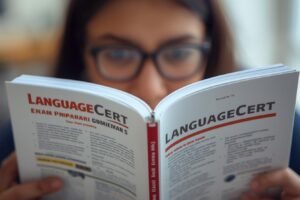
Start with the official LanguageCert Practice Papers. These are the closest things to the real exam. Working through them highlights exactly which sections need the most attention.
Beyond official materials, a peer-reviewed review published by Taylor & Francis notes that the Achiever test measures real-life communicative tasks rather than academic language.
Practising everyday topics and situations is more effective than studying grammar rules in isolation. For Writing practice, count words on every single draft. The formal task has a 70-100-word limit. The informal task requires 100-120 words.
Going over or under noticeably affects marks. Practising within those ranges until it becomes automatic removes one source of exam-day stress completely.
Candidates planning to Study in Australia should verify that their chosen institution or visa pathway accepts the LanguageCert International ESOL. Recognition is growing, but checking directly with the institution before booking is still the safest approach.
Ready to Take the Next Step?
Passing the LanguageCert B1 exam opens the door to international study opportunities across Europe, Australia, Canada, and beyond. Safari Foreign Education & Immigration helps students navigate every step of that journey, from exam preparation advice to university applications and visa support.
Get in touch today and start the process with guidance that actually makes a difference.
Understanding the Scoring System
Each skill in the LanguageCert B1 exam carries equal weight. The pass mark sits at 50% overall in both the Written and Spoken exams. For the SELT version, candidates need a minimum score of 33 points in each section. Falling short in one section can fail the entire component even with strong scores elsewhere.
Grades come in three tiers: Pass, High Pass, and Fail. Most visa and admission requirements only need a standard Pass. However, some universities, particularly those with competitive intakes, look for a High Pass in specific skills. Checking the exact requirement before exam day avoids unpleasant surprises.
Results typically arrive within three working days for online exams. Test centre results may take slightly longer. Successful candidates receive a full certificate showing scores per skill, overall score, and CEFR level confirmation.
Students targeting opportunities to Study in Canada should note that Canadian institutions set their own English proficiency thresholds. A Pass may clear some pathways while a High Pass opens others.
Frequently Asked Questions
Can the Written and Spoken exams be taken on different days?
Yes. Both must be completed within a 14-day window, but the order is flexible.
Is the LanguageCert B1 exam accepted for UK visa applications?
Only the SELT version is approved by UKVI. The International ESOL version does not qualify for UK visa purposes.
What is the passing score for the LanguageCert B1 exam?
Candidates need at least 50% overall in both Written and Spoken exams. The SELT version requires a minimum of 33 points in each section.
How long does preparation typically take?
Four to six weeks works well for someone at a solid A2 level. Lower starting levels may need two to three months.
Can a failed component be retaken without redoing the full exam?
Yes. The Written and Spoken components are separate. Failing one does not require retaking the other.
Are free preparation materials available?
LanguageCert provides free official practice papers and interactive preparation activities called Step to Success. These are added automatically to the candidate’s account after booking.
The LanguageCert B1 exam guide comes down to one thing: preparation that matches how the exam actually works. Know the format, practice the right way, and the result follows.

You may also like
The 75 Score Blueprint for LanguageCert: Strategy Over Skill

Top 7 German Universities for Pakistani Students to Study in 2026